Every retailer faces a delicate balancing act: having enough stock to meet customer demand without holding so much that it ties up capital and becomes a burden. This constant tension between too much and too little inventory can silently erode your profitability and impact customer satisfaction. Understanding the full financial impact of both overstock and stockouts is crucial for making informed strategic decisions.
The silent drain of excess inventory
Overstock, or excess inventory, often appears as a safety net, but it quietly drains resources and significantly impacts your bottom line. It’s not just about the items sitting in your warehouse; it is about the money those items represent and the costs associated with holding them. Retailers globally lose an estimated $650 billion annually due to overstocking, highlighting the pervasive nature of this issue.
The financial implications of carrying too much inventory are multifaceted and relentless, impacting various aspects of your operations. Here are the key ways excess inventory diminishes profitability:
- High carrying costs
These are the direct expenses associated with holding inventory, including warehousing, insurance, and security, which can collectively amount to 25 to 30% of inventory value annually.
- Increased risk of obsolescence
Fashion trends change rapidly, and holding onto inventory too long increases the likelihood that products become outdated, losing their appeal and value.
- Forced markdowns
To clear unsold inventory, retailers often resort to significant markdowns, with the fashion industry alone facing 10 to 15% markdown rates for unsold inventory, directly eroding profit margins.
- Tied up capital
Every dollar spent on inventory is a dollar that cannot be invested elsewhere, restricting cash flow and limiting opportunities for growth and innovation.
Addressing excess stock requires a clear strategy for managing and reducing at-risk inventory. By implementing precise forecasting and allocation strategies, retailers can mitigate these financial drains and unlock capital. To learn more about proactive approaches, explore our insights on strategic management of excess and at risk inventory.
The hidden cost of stockouts and lost opportunities
While overstock drains resources, stockouts represent immediate lost sales and enduring damage to customer loyalty. A stockout occurs when a product a customer wants is unavailable, leading to frustration and often, a lost purchase. This issue is more prevalent than many realize, with stockouts resulting in 4.1% of lost sales for general merchandise retailers.
The consequences of stockouts extend far beyond a single missed transaction, impacting your brand’s reputation and long-term customer relationships. Consider these significant costs:
- Direct lost sales
When a customer cannot find a desired item, they often purchase it from a competitor, leading to an immediate revenue loss, with stockouts causing 7 to 25% of lost sales.
- Customer dissatisfaction and abandonment
A negative shopping experience due to unavailability often prompts customers to abandon their purchases, with 60% of consumers choosing to shop elsewhere.
- Erosion of brand loyalty
Repeated stockouts can significantly diminish a customer’s trust and loyalty, potentially reducing future purchases by 15 to 20% after just one negative experience.
- Negative word of mouth
Dissatisfied customers are likely to share their negative experiences, harming your brand’s reputation and deterring potential new customers.
Understanding how to prevent in store stockouts is crucial for maintaining customer satisfaction and protecting your sales pipeline. Discover strategies to enhance product availability by reading about the role of AI in predicting and preventing in store stockouts.
Calculating the true financial impact a deeper dive
To truly grasp the impact of inventory imbalances, retailers must move beyond surface-level observations and quantify the costs associated with both overstock and stockouts. This detailed calculation reveals the substantial financial leaks that might otherwise go unnoticed.
Quantifying the cost of overstock
The cost of overstock involves several direct and indirect expenses that accumulate over time. Each component chips away at your profit margins, making it imperative to manage inventory efficiently.
- Storage costs
These encompass rent or mortgage for warehouse space, utilities, labor for inventory handling, and security measures, all of which increase with the volume of excess goods.
- Capital costs
The money tied up in excess inventory could be generating returns elsewhere, representing an opportunity cost equivalent to the interest you might earn or the cost of borrowing capital.
- Shrinkage and obsolescence
This includes losses due to theft, damage, or products becoming obsolete before they can be sold, leading to a complete loss of their original value.
- Markdown costs
The need to discount products to clear excess stock directly reduces your gross profit margin on those items, impacting overall profitability.
Quantifying the cost of stockouts
The costs associated with stockouts are primarily opportunity costs, representing revenue and customer relationships lost due to product unavailability. These are often harder to track but are equally, if not more, damaging.
- Direct lost sales
This is the most immediate and obvious cost, representing the revenue from specific items that were not sold because they were out of stock.
- Lost customer lifetime value
A customer who leaves due to a stockout might not return, meaning all their potential future purchases are lost to a competitor.
- Expedited shipping costs
To mitigate stockouts, some retailers incur additional expenses by expediting orders or transferring stock between locations, reducing profit per item.
The critical role of inventory optimization
Balancing the twin threats of overstock and stockouts requires more than just educated guesswork. Traditional inventory management methods often fall short, relying on historical data that may not accurately predict future demand in today’s dynamic retail landscape. The key lies in precise inventory optimization through advanced analytical tools.
Modern retail demands a proactive approach, where demand forecasting and allocation are not just reactive processes but strategic imperatives. This is where the power of agentic AI becomes indispensable.
How agentic AI transforms inventory challenges into profit drivers
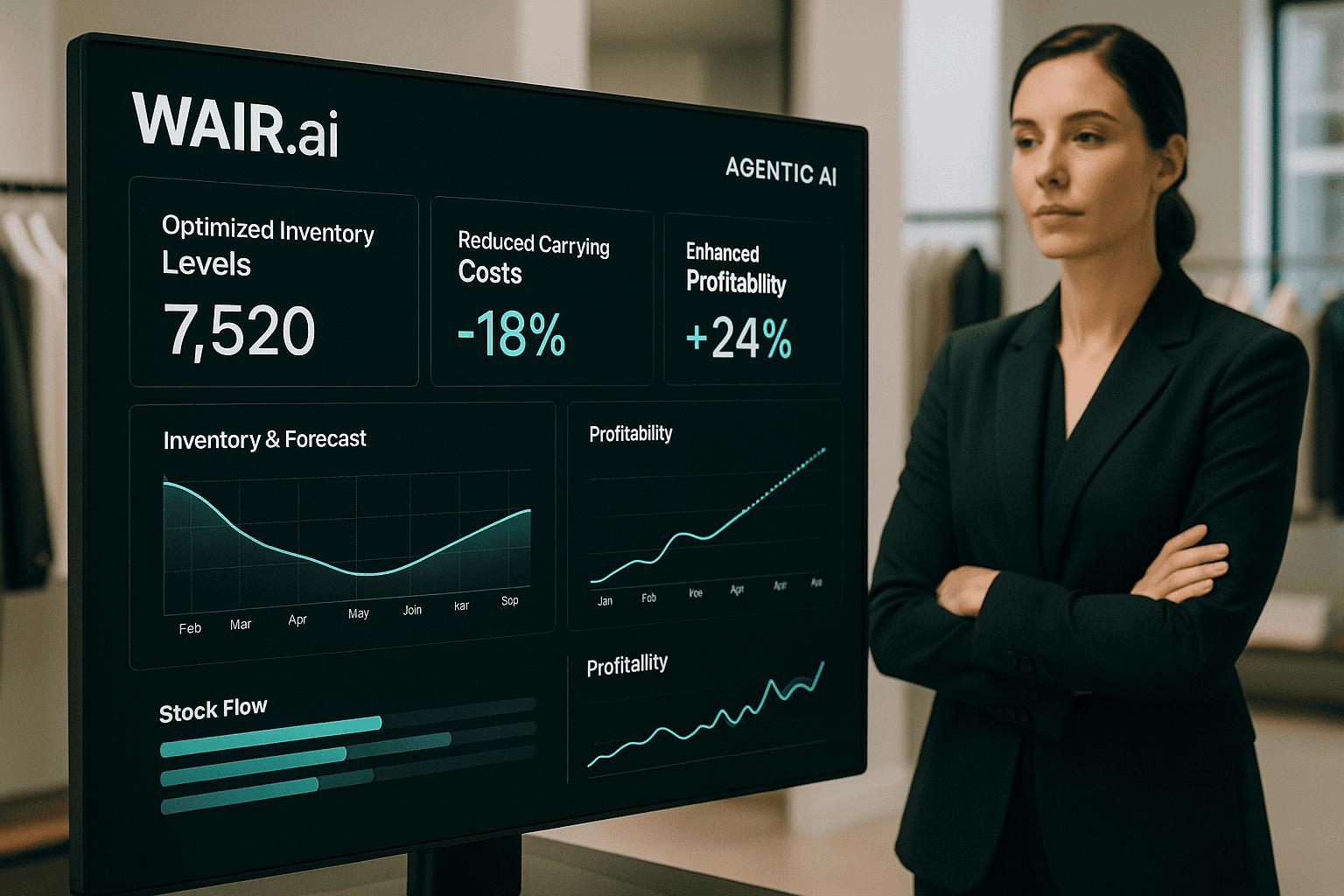
WAIR.ai, as an agentic AI company, offers sophisticated solutions that move beyond simple automation. Our approach leverages deep learning models to predict demand with unprecedented accuracy, directly tackling the financial leaks caused by overstock and stockouts. AI can achieve 90 to 95% forecast accuracy, a significant leap from traditional methods. This precision allows retailers to reduce overstock by 20 to 30% and stockouts by 15 to 25%, directly improving financial outcomes.
Wallie the allocator ensuring optimal stock levels
Our flagship solution, Wallie, is designed to revolutionize your inventory management. It is an agentic AI that acts as your dedicated allocator, optimizing every step of your inventory journey.
- Demand prediction accuracy
Wallie utilizes our proprietary ForecastGPT-2.5 model, integrating diverse data points like demographics, weather, and geography to achieve highly accurate demand forecasts at the SKU level.
- Overstock reduction
By precisely predicting what customers will buy and where, Wallie ensures you do not carry excessive inventory, significantly reducing carrying costs and markdown risks.
- Stockout prevention
Wallie’s intelligent retail replenishment and redistribution capabilities ensure that popular items are always available where and when customers want them, preventing lost sales and enhancing customer satisfaction.
Learn more about how precise inventory control can elevate your retail performance by exploring our solutions in AI inventory management.
Suzie the content creator supporting sell through
While Wallie manages the physical inventory flow, Suzie plays a crucial role in enhancing product appeal and ensuring successful sell through. Suzie is an agentic AI content creator that automates the generation of product tags, titles, and descriptions.
- Consistent product information
Suzie ensures every product has compelling and accurate descriptions, which is vital for customer understanding and reducing returns.
- Global market readiness
With the ability to translate content into over 100 languages, Suzie makes global expansion seamless, ensuring that products are understood and desired across diverse markets.
By providing clear, engaging, and localized product information, Suzie indirectly supports inventory efficiency by minimizing returns due to misunderstood product details and by accelerating sales across all channels.
Achieving sustainable profitability with precise inventory management
The financial impact of inventory imbalance is no longer an insurmountable challenge. By embracing agentic AI solutions like Wallie and Suzie, fashion and lifestyle retailers can transition from reactive inventory management to proactive, data driven strategies. This shift leads to tangible benefits, including improved profit margins, significantly reduced waste, and enhanced customer satisfaction, laying the groundwork for sustainable growth.
The path to optimized inventory and increased profitability begins with actionable insights and cutting-edge technology. For a deeper understanding of how these metrics translate into real world gains, refer to key inventory performance indicators for strategic retail management.
Frequently asked questions about inventory financial impact
Navigating the complexities of inventory management often leads to specific questions about its financial implications and potential solutions. Here are some common inquiries.
Q: What is the average inventory carrying cost for retailers?
A: The average inventory carrying cost for retailers typically ranges from 25 to 30% of the inventory’s value annually, encompassing expenses like warehousing, insurance, and obsolescence.
Q: How do stockouts directly affect customer loyalty?
A: Stockouts can significantly erode customer loyalty, with studies showing that a single stockout experience can reduce a customer’s willingness to return by 15 to 20% due to frustration and inconvenience.
Q: Can AI truly balance inventory effectively, preventing both overstock and stockouts?
A: Yes, agentic AI solutions leverage advanced deep learning models to achieve 90 to 95% forecast accuracy, enabling retailers to simultaneously reduce overstock by 20 to 30% and prevent 15 to 25% of stockouts.
Q: What distinguishes agentic AI from traditional inventory software?
A: Agentic AI goes beyond basic automation by independently identifying problems, predicting outcomes, and executing solutions, offering a more dynamic and intelligent approach to inventory management compared to traditional software that relies heavily on predefined rules and human input.
Taking the next step towards optimized inventory and increased profits
The financial health of your retail business hinges on intelligent inventory management. By mitigating the high costs of overstock and eliminating the lost opportunities of stockouts, you can unlock significant profitability and build stronger customer relationships.
Are you ready to transform your inventory challenges into a powerful competitive advantage? Explore how WAIR.ai’s agentic AI solutions, Wallie and Suzie, can provide the precision and efficiency your business needs. We invite you to schedule a meeting with our experts to discuss a tailored strategy for your brand and discover our transparent AI pricing solution.